THE FIRST TRACK I Made is roughly 48–52 cents below the 455.4-Hz target.
We can make this track genuinely A4 = 455.4 Hz by pitch-shifting the complete WAV upward while keeping the tempo unchanged.
We use approximately +50 cents based on the actual recording rather than blindly applying +59.8 cents.
From my first creation, we converted this exact HertZ.wav to 455.4 Hz and that gives us the corrected WAV. In the second version.
Ray of the Rola Colas…
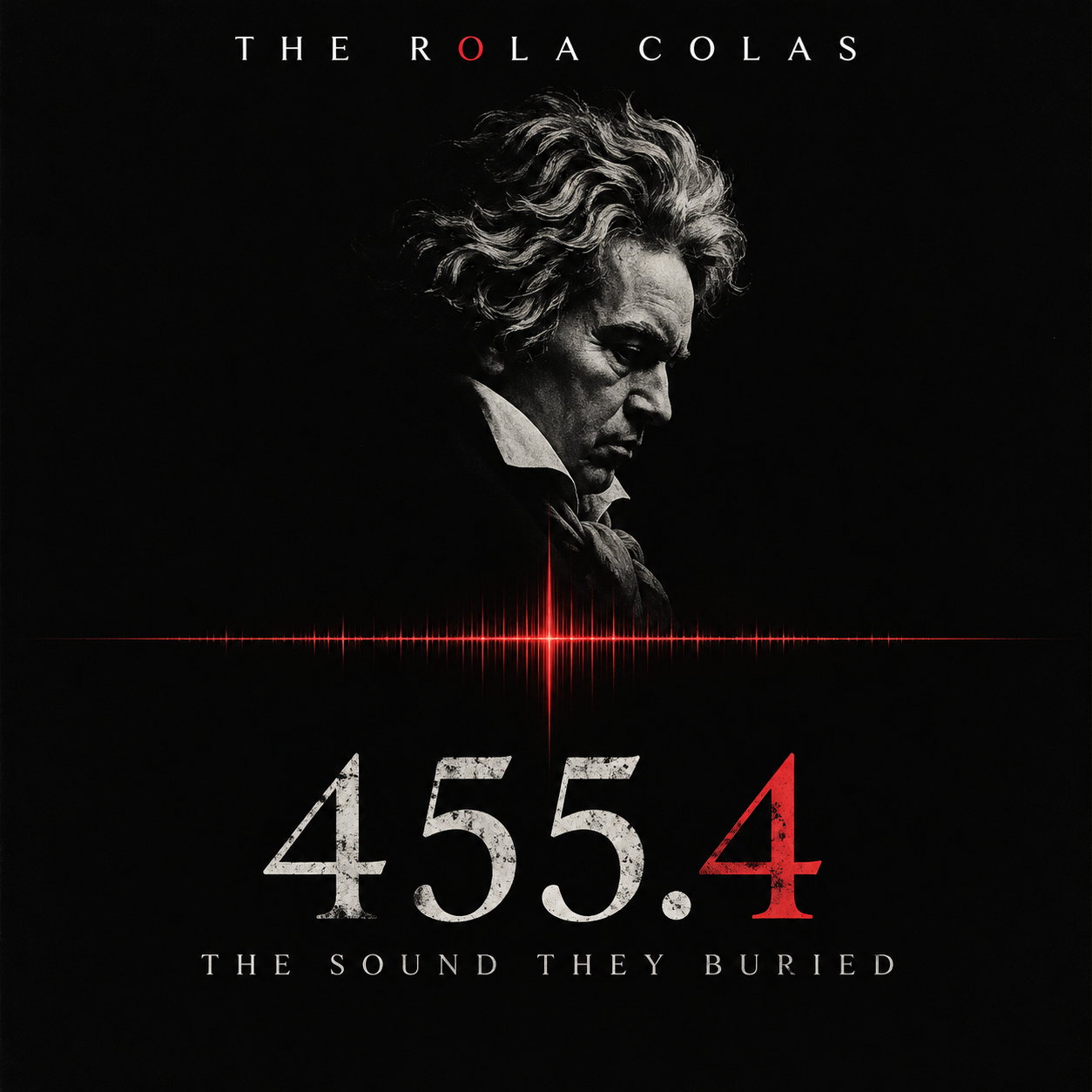
455.4 — The Sound They Buried
What if the sound we hear today isn’t quite the sound they heard yesterday?
Every now and then, an idea comes along that makes you stop and listen.
For The Rola Colas, that idea became 455.4 Hz.
The number refers to a musical tuning reference: A4 = 455.4 Hz, rather than the modern standard reference of A4 = 440 Hz.
That difference may sound small on paper, but when you start thinking about music, tuning and history, it opens up an interesting question:
What did music actually sound like to people hundreds of years ago?
Beethoven enters the story
Few composers are more closely associated with the power of sound than Ludwig van Beethoven.
Beethoven lived during a period when musical pitch was not governed by one universal international standard. Different orchestras, cities and periods could use different pitch references.
That means the precise pitch of historical performances could differ from what we are accustomed to hearing today.
Beethoven’s relationship with sound is particularly fascinating because he experienced profound hearing loss during his lifetime, yet continued to compose some of the most remarkable music ever written.
But here’s where the Rola Colas story takes a turn.
What if something was lost?
There is no established historical evidence that a 455.4 Hz musical system used by Beethoven was deliberately removed from history.
That’s not the claim I’m making.
Instead, the song takes the idea and turns it into a musical mystery.
What if an old sound disappeared through changing musical standards?
What if generations of musicians gradually moved toward different reference pitches?
And what if, somewhere along the way, a particular sonic character simply became part of the past?
Not erased by some secret organisation.
Not hidden in a vault.
Just changed by history.
Why 455.4?
The interesting thing about 455.4 Hz is that it isn’t just a number we have put into the lyrics.
The idea behind the track is to make 455.4 Hz the musical reference point itself.
If A4 is set to 455.4 Hz, the other notes can be mathematically derived from that reference.
That means the entire musical structure can theoretically be tuned around it — guitars, bass, keyboards and vocals.
So instead of simply singing:
“455.4”
we’re asking the music itself to live around the number.
The experiment
That’s what makes this a Rola Colas experiment.
Take a familiar style — Northern indie, Madchester grooves, Britpop influences, gritty guitars and a rolling bassline — and put it into a different tuning environment.
Then add a mysterious lyric about Beethoven, lost sounds and changing musical standards.
The result isn’t intended to rewrite music history.
It’s intended to make you listen differently.
Because perhaps the most interesting question isn’t:
Was a frequency deliberately removed from history?
Maybe it’s:
How much does changing the tuning actually change the feeling of a piece of music?
That’s something you can hear for yourself.
The mystery remains
Beethoven didn’t leave us a secret instruction saying:
“Use 455.4 Hz.”
There is no reliable historical evidence that he used that precise reference as a universal tuning system.
But music history does tell us that pitch standards have changed considerably over time.
And that leaves plenty of room for imagination.
So 455.4 — The Sound They Buried isn’t a historical documentary.
It’s a musical thought experiment.
A question disguised as a song.
A number turned into a frequency.
And a frequency turned into a mystery.
So turn it up.
Listen carefully.
Forget 440 for a moment.
And ask yourself:
What does 455.4 sound like?
The Rola Colas — 455.4
Four-five-five point four…
…listen…
455.4