“Et Al.” — and others.
One academic writes a theory. Another quotes it. A third cites them both. Soon the references run for pages, the terminology gets more complicated, and somewhere along the way nobody stops to ask the simplest question”
Doherty (2010)
“Et Al.” — When Education Stops Teaching and Starts Programming
What happens when the people trusted to educate our children stop teaching them how to think and start teaching them what to think?
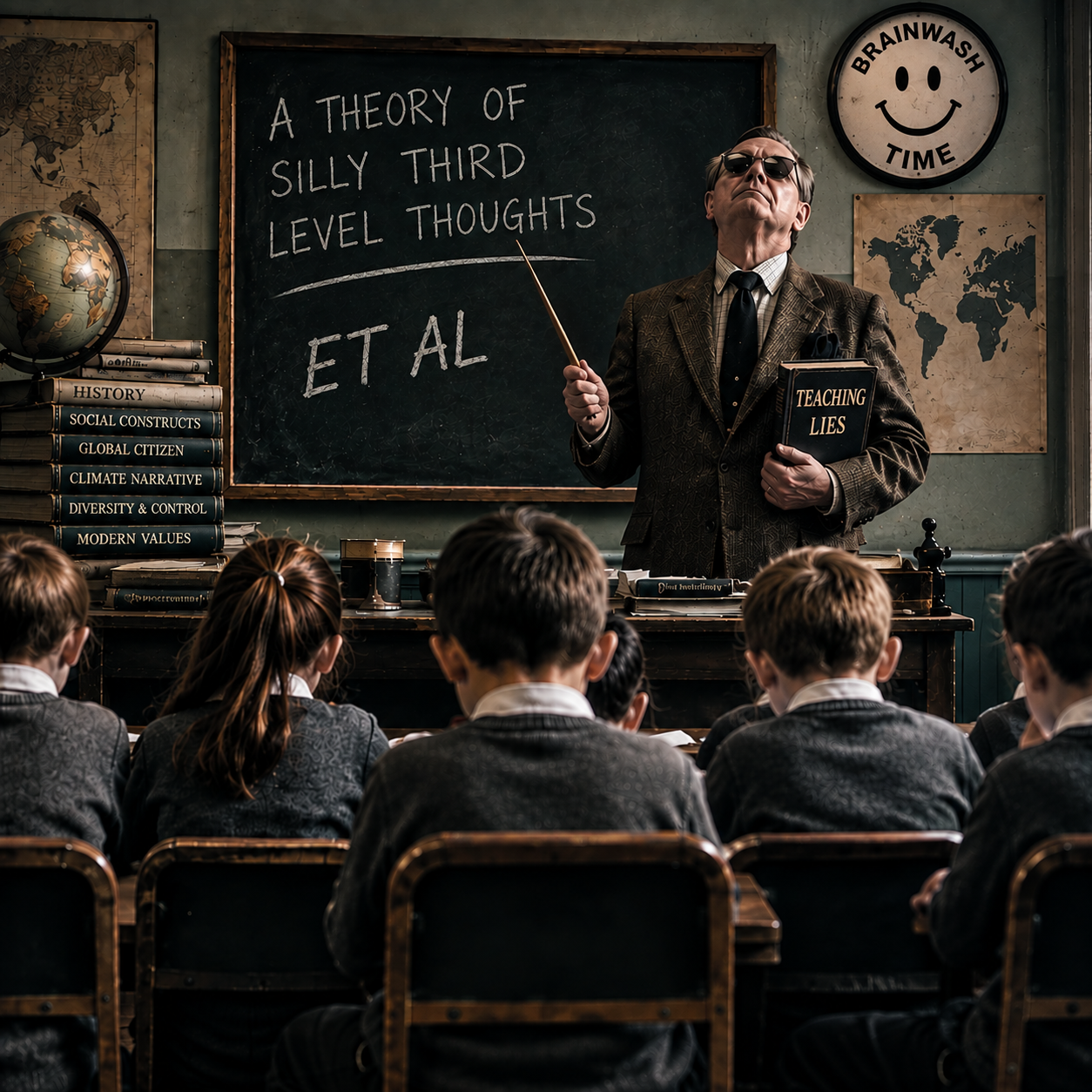
That is the question behind my new song, “Et Al.”
I’m not attacking every teacher. I’m attacking an attitude — the pompous certainty of people who have spent years inside universities, collected degrees, read endless theories and then present those theories to children as though they are unquestionable truth.
“Et Al.” — and others.
One academic writes a theory. Another quotes it. A third cites them both. Soon the references run for pages, the terminology gets more complicated, and somewhere along the way nobody stops to ask the simplest question:
But is it actually true?
Children are naturally curious. They ask why? They challenge things. They want evidence.
Yet somewhere between primary school, university and the workplace, questioning can become inconvenient. Conformity becomes achievement. Repeating the accepted answer becomes success.
And the teacher standing at the front of the classroom becomes the authority.
A degree does not make someone infallible. A textbook does not make an idea true. A citation does not turn a theory into fact.
And “Et Al.” certainly doesn’t.
Education should give children the tools to examine an argument, challenge an assumption, recognise propaganda, demand evidence and reach their own conclusions.
Instead, too often, we seem obsessed with producing children who fit neatly into the system.
Get the grades.
Get the qualification.
Get the respectable job.
Join the queue.
Play the game.
And don’t ask too many questions.
My song “Et Al.” is a protest against that mindset.
Because children don’t need pompous people telling them what to believe.
They need the freedom to ask why.
Strip away the jargon. Strip away the status. Strip away the endless references.
Then ask the question that should never disappear from a classroom:
Where’s the proof?
That is what “Et Al.” is about.
Not telling children what to think.
Teaching them to think.
Who?