The Suppressed Poet — The True Story Behind the Song
Some songs are made up.
Some songs are inspired by something that happened.
And then there are songs that are simply your life put into words.
“The Suppressed Poet” is one of those songs.
Every word comes from a real part of my story.
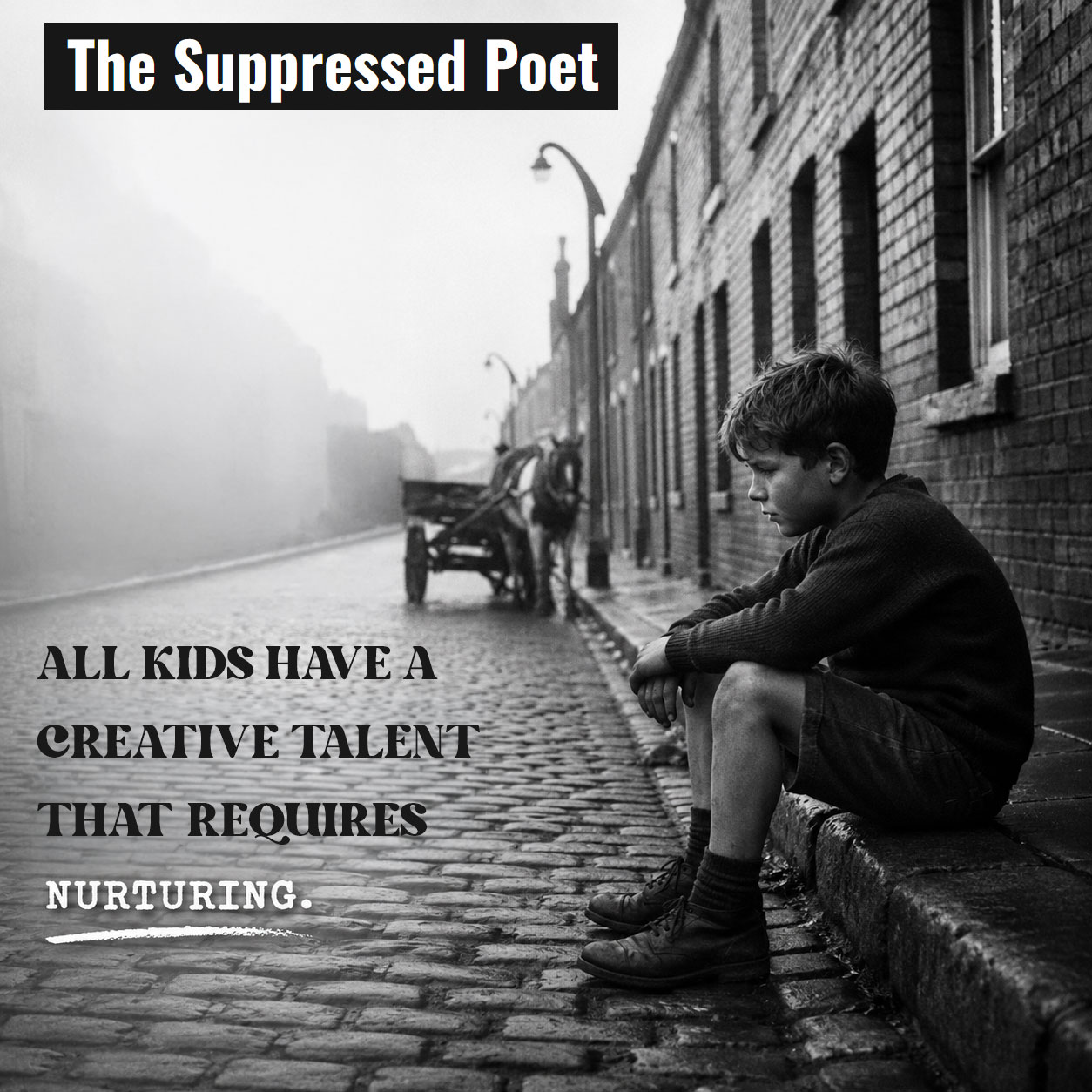
I was 11 years old when I first started getting the urge to write. I had rhymes running around in my head, little ideas, lines and words that I wanted to put somewhere. I wanted to make music. I wanted a guitar, a piano, drums — anything that would let me turn the ideas in my head into something people could hear.
But there was a problem.
My dad wasn’t interested in music as a career or a way of life. To him, music wasn’t something that would lead anywhere. As the song says:
“But my dad was an oldie, said that music is for bums.”
At the time, those words mattered.
When you’re eleven years old, you don’t necessarily have the confidence to stand up and say, “No, you’re wrong. This is what I want to do.”
So I kept it inside.
I would sing on my own.
I would write on my own.
I would make up rhymes in my head.
And those cold, lonely moments became part of who I was.
The poet didn’t disappear
The interesting thing is that the young lad didn’t stop writing.
He didn’t disappear.
He just went underground.
The music was still there.
The rhymes were still there.
The ideas were still there.
Years passed, life happened, work happened and responsibilities came along. But somewhere inside me, that eleven-year-old kid was still writing.
That’s why the line:
“But little did he know, in my head were the rhymes”
means so much to me.
The music couldn’t be stopped simply because nobody was listening.
It was already there.
Making music on my own
Today I can finally do something that eleven-year-old me could only dream about.
I can take those ideas and turn them into songs.
I can experiment with sounds, voices, instruments, rhythms, lyrics and production. I don’t need somebody standing over me telling me whether I’m allowed to create.
And that’s where the song becomes happy.
Not because the past didn’t happen.
But because the little boy who once had nowhere to play eventually found somewhere to make his music.
That’s the satisfaction I’m talking about in the chorus.
It’s difficult to explain that feeling unless you’ve experienced it.
You have an idea in your head.
You turn it into words.
Then you hear it become a song.
Suddenly, something that existed only inside your imagination is sitting in front of you as a finished piece of music.
That’s a pretty amazing feeling.
The poet was suppressed, not destroyed
I chose the title because that young version of me was suppressed, but he wasn’t destroyed.
There is a difference.
You can suppress creativity.
You can tell someone that their ideas aren’t important.
You can make someone hide their writing.
You can make a child think their dreams are silly.
But you can’t necessarily remove the need to create.
Sometimes it just takes longer to come back out.
And when it does, it can come back stronger.
The three “Thank yous”
At the end of the chorus I say:
“Thank you…
Thank you…
Thank you…”
Those words are deliberately simple.
They’re partly gratitude.
Gratitude for finally being able to make the music.
Gratitude for the people who listen.
But they’re also a little message to that eleven-year-old kid.
You made it.
You didn’t give up completely.
You kept the rhymes.
You kept the ideas.
You kept the poet alive.
And what about AI?
There is another part of this story worth mentioning.
If, after reading all of this, you still believe that AI cannot be helpful to a songwriter, then I think you’re missing an important part of what actually happened here.
AI didn’t give me the memories.
It didn’t give me the childhood.
It didn’t create the eleven-year-old boy who sat there with rhymes in his head.
That was me.
The story, the experiences, the feelings and the ideas came from my own life.
What AI has given me is another set of tools to help turn those ideas into something I can actually hear.
For someone who spent years wanting to make music but didn’t always have the instruments, musicians or circumstances to do it, that is incredibly powerful.
AI didn’t replace the suppressed poet.
It gave him a way to finally be heard.
And that’s the difference.
The creativity came first.
The story came first.
The human experience came first.
The technology simply helped me bring it to life.
This isn’t fiction
“The Suppressed Poet” isn’t a character I’ve invented.
It’s not a fictional childhood story written to make a song sound emotional.
It’s my story.
The eleven-year-old boy in the song was me.
The desire to make music was real.
The disappointment was real.
The loneliness was real.
The writing was real.
And the happiness I feel now when I can create music on my own is real too.
That’s probably why the song means more to me than some of the others.
It’s not just a song about the past.
It’s a conversation between who I was and who I am now.
The little lad who once had to hide his rhymes eventually grew up and decided he wasn’t hiding anymore.
So this one is for every kid who has ever been told that their creativity isn’t worth anything.
Keep writing.
Keep drawing.
Keep playing.
Keep creating.
Because sometimes the thing that gets pushed into the corner at eleven years old is the very thing that eventually becomes your voice.
The suppressed poet was never gone.
He was just waiting for his turn.
Thank you.
Thank you.
Thank you.
And then there are songs that are simply your life put into words.