
“Speaking lies in hypocrisy, proud of your lyin’…having your conscience seared…
comfortably numbed, with YAHWEH’S hot iron.” …
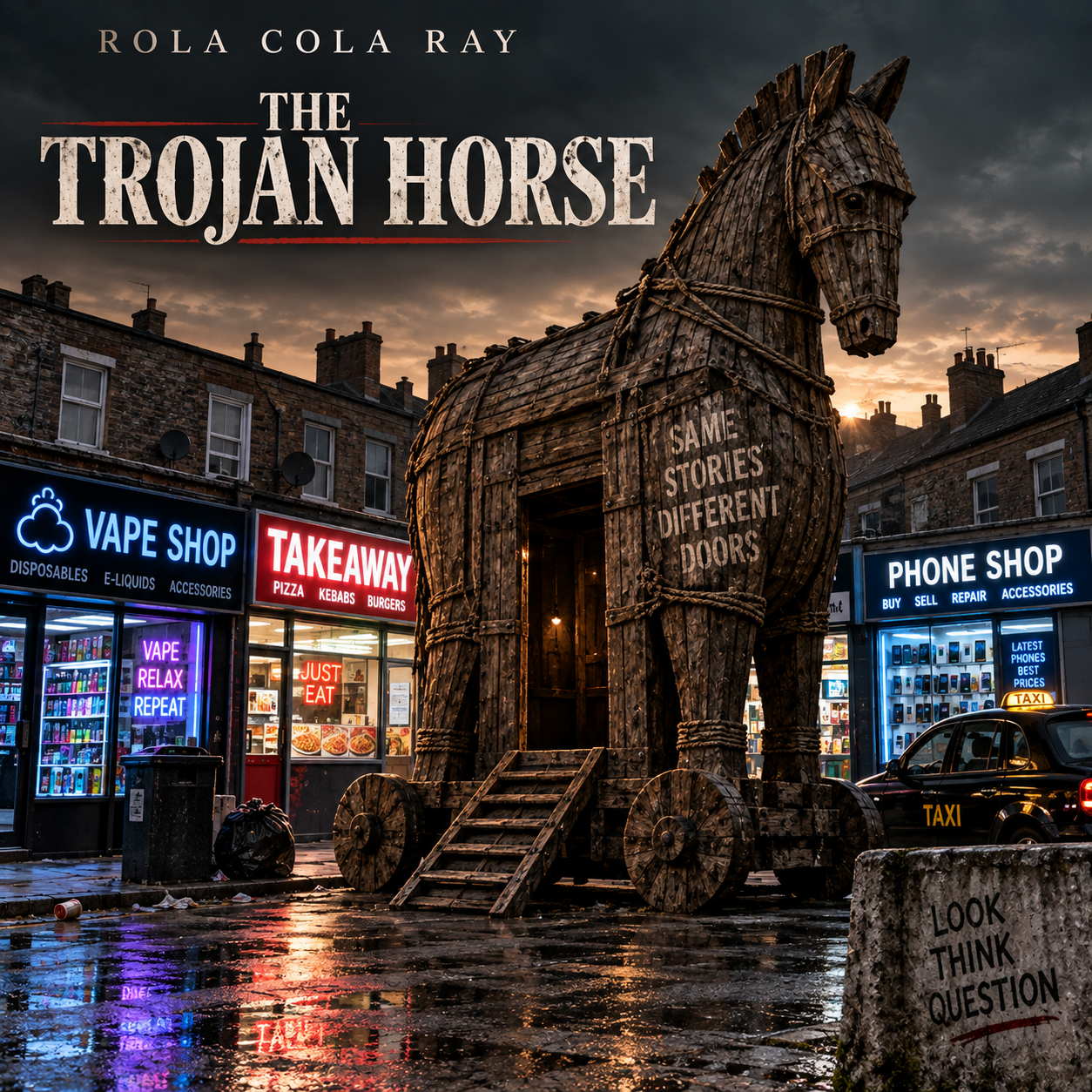
THE TROJAN HORSE
A Seared Conscience and a Blind Eye
The Trojan Horse is my new Rola Cola Ray song about something I believe is becoming increasingly difficult to talk about: the things we see every day, the questions we have, and the temptation to simply look away.
The song isn’t about accusing individual people, businesses, charities or organisations of wrong doing.
It is about conscience.
It is about the blind eye.
And it is about what happens when a conscience becomes so accustomed to something that it stops reacting.
The Bible describes this as having a “seared conscience” — a conscience that has become hardened and insensitive.
My opening words deliberately use that imagery:
“Speaking lies in hypocrisy, proud of your lyin…
having your conscience seared…
comfortably numbed, with YAHWEH’S hot iron.”
That is deliberately uncomfortable language.
Because the song is asking whether we can become so comfortable with what surrounds us that we no longer stop and ask whether something is right or wrong.
THE TROJAN HORSE
The Trojan Horse is the central metaphor.
Something can arrive looking harmless.
It can look respectable.
It can look useful.
It can even look like something we should welcome.
But sometimes the important question isn’t simply what something looks like from the outside.
It is:
What’s inside?
That doesn’t mean assuming the worst.
It means keeping our eyes open.
THE EMPTY SHOP
One of the images behind the song is the modern town centre.
You see shops, takeaways, vape shops, phone shops and other businesses operating alongside one another.
Sometimes you see premises that appear remarkably quiet.
And naturally, you might wonder how any business manages when there are rents, rates, electricity, insurance, staff, stock and all the other costs involved in keeping a shop open.
That doesn’t prove anything sinister.
There may be perfectly ordinary explanations.
But asking “How does this work?” is not an accusation.
It is a question.
And questions are at the heart of this song.
The point isn’t to condemn the shopkeeper standing behind the counter.
The point is to recognise how easily we can walk past things every day without giving them another thought.
We see them.
We accept them.
We move on.
That’s where the idea of the blind eye comes in.
THE CHARITY APPEAL
The same principle applies to the constant stream of appeals we see on television and online.
My lyrics say:
“Charities on the telly, askin through pain…
Hands in your pocket, same script again..
They want your money.. they play to your heart…
They never find the cure, finance the human mart…”
These lines are deliberately provocative.
They aren’t saying every charity is dishonest.
There are countless people working genuinely to help others.
The question is about what happens inside our own minds when we see suffering presented to us again and again.
Do we think?
Do we ask?
Do we understand what we are supporting?
Or do we simply react emotionally, reach for our wallets and move on?
Again:
Questioning isn’t accusing.
“YOU CAN SEE IT”
The song then becomes more personal:
“You can see it…
on our streets…
Politicians laugh…
in their silence…”
And then comes the line that really drives the whole song:
“And when everybody tells you…
not to ask questions…
That’s when…
you ask.”
That doesn’t mean believing every rumour.
It doesn’t mean deciding that every suspicion must be true.
It means refusing to surrender your ability to think.
THE BIBLICAL WARNING
There is a much deeper biblical theme running underneath the song.
Romans 1:25 speaks about people “exchang[ing] the truth of God for a lie” and worshipping and serving the created rather than the Creator.
That idea is central to The Trojan Horse.
What happens when we become more concerned with the things around us than with truth?
What happens when money, status, politics, possessions, institutions or ideology become more important than conscience?
And what happens when we know something doesn’t sit right with us — but decide that it is easier not to look?
The song’s answer is uncomfortable:
The conscience can become numb.
“YOU DON’T NEED TO SHOUT”
The song doesn’t end by calling for violence or confrontation.
It says:
“You don’t need to shout…
You don’t need to fight…
Just open your eyes.
Look.
Think.
Question.”
That is the message.
Not believe everything I say.
Not condemn everybody you disagree with.
And certainly not assume that suspicion equals truth.
Instead:
Look.
Think.
Question.
And then make up your own mind.
THE BLIND EYE
Perhaps the most dangerous thing isn’t the thing we don’t know.
Perhaps it is the thing we see but choose not to see.
We can become accustomed to almost anything.
A strange-looking town centre.
A permanently quiet shop.
Another emotional appeal on television.
Another political promise.
Another headline.
Another explanation.
Eventually, we can become so accustomed to it all that we don’t even notice that we have stopped questioning.
That’s the blind eye.
And when the conscience stops reacting, that is the seared conscience.
WHY “THE TROJAN HORSE”?
Because the Trojan Horse is ultimately about what we allow through the gates.
We don’t always recognise something for what it is when it first arrives.
Sometimes we welcome it.
Sometimes we ignore it.
Sometimes we simply don’t bother looking closely.
And sometimes we discover too late that we should have asked questions at the beginning.
That’s why the song ends with:
REAL FAST.
Because waking up to something can happen in an instant.
One moment you don’t notice.
The next moment you see it.
And once you start looking, you may start asking questions you should have asked a long time ago.
Not with hatred.
Not with violence.
Not with accusations.
Simply with an awake conscience.
Look.
Think.
Question.
Because the greatest danger may not be that we fail to see.
It may be that we see — and deliberately look away.
Who?