“The Rola Colas and I disagree fundamentally with the idea that human identity is something institutions should redefine for us — particularly when the subject is children.”
GENDER OF CHANGE
A Rola Colas Warning
There are subjects that are difficult to discuss today without being immediately labelled, dismissed or shouted down.
This is one of them.
The Rola Colas and I disagree fundamentally with the idea that human identity is something institutions should redefine for us — particularly when the subject is children.
Our position is simple: children deserve time, protection and the freedom to grow up before adults ask them to make sense of questions that even adults continue to argue about.
We believe biological sex matters. We believe that being born male or female is a biological reality, not merely a statement that can be rewritten whenever society changes its terminology. And we believe that questioning this does not make someone hateful.
It makes the question worth asking.
When did childhood become a political battleground?
A child can be confused. A child can experiment. A child can dislike the expectations traditionally associated with being a boy or a girl. A child can ask difficult questions about themselves.
That is part of growing up.
But there is an enormous difference between allowing a child to explore a question and telling that child that an answer has already been decided for them.
Even the direction of official policy has changed considerably. The Cass Review raised major concerns about the evidence base surrounding interventions for children and adolescents, and UK guidance now stresses caution, safeguarding, professional curiosity and parental involvement.
The current Keeping Children Safe in Education 2026 framework places safeguarding at the centre of schools’ responsibilities.
That should tell us something.
This isn’t a settled subject.
Parents must not become spectators
We also believe parents have a fundamental role in their children’s lives.
A school, government department, campaign group, medical organisation or social-media influencer should not become more important than a child’s own family.
If an institution is making decisions concerning a child’s identity, wellbeing or development, parents should know what is happening and should have a meaningful opportunity to question it.
The government’s current guidance specifically recognises the importance of parental involvement wherever possible and calls for caution concerning social transition of pre-pubertal children.
That’s not extremism.
That’s safeguarding.
Questioning the system isn’t hatred
We don’t hate transgender people.
We don’t believe that someone should be bullied, abused or humiliated because they feel differently about themselves.
Every person deserves dignity.
But dignity does not require surrendering the right to disagree.
We can respect an individual while questioning an ideology.
We can listen to someone while disagreeing with their conclusions.
We can care about vulnerable people while asking whether the institutions responsible for helping them actually have all the answers.
And when children are involved, we believe those questions should become even louder.
Who gets to decide what a human being is?
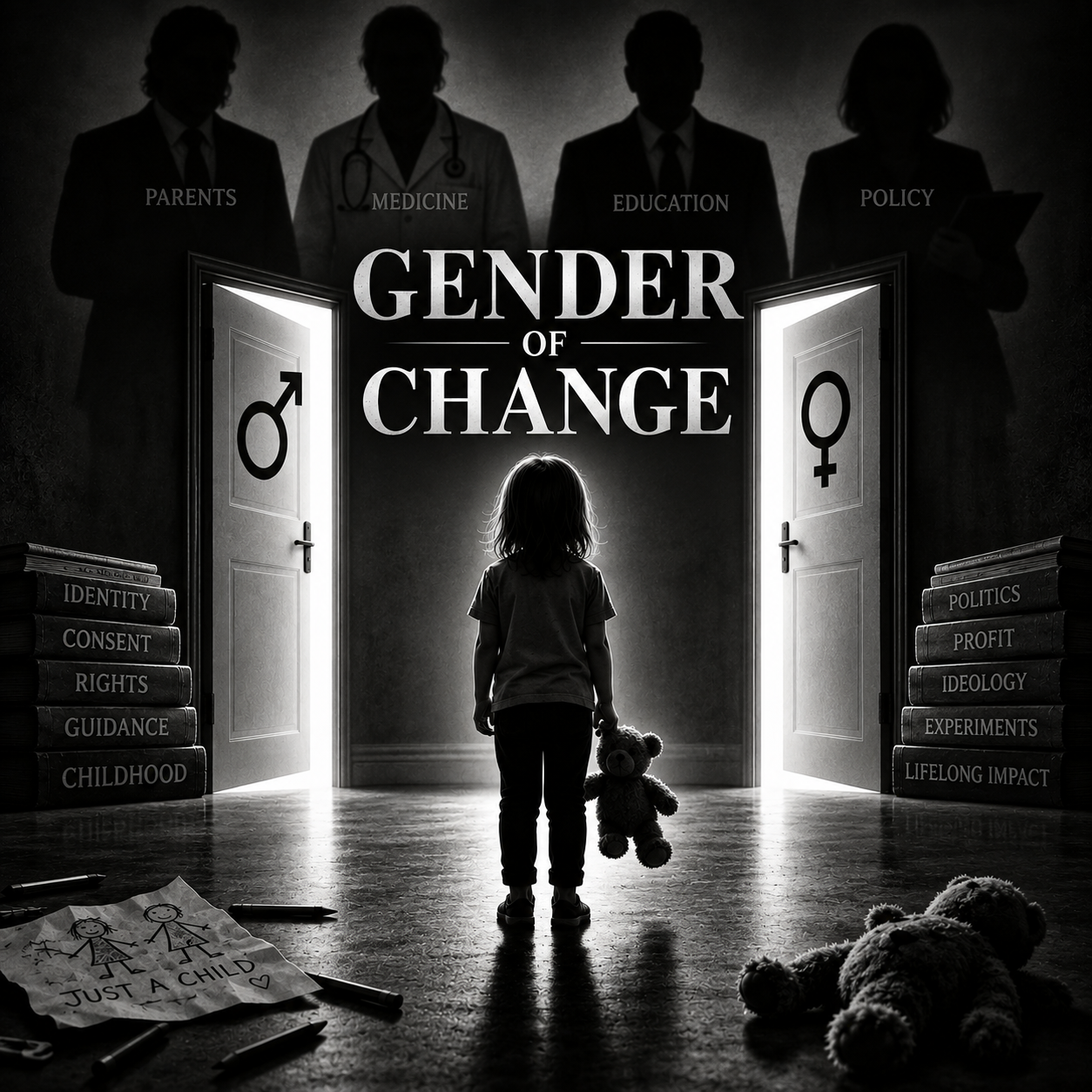
That’s the question behind Gender of Change.
Who decides?
Parents?
Children?
Teachers?
Doctors?
Politicians?
Campaign organisations?
Social media?
Or the individual?
And if the answer is supposed to be the individual, at what age does that responsibility begin?
These aren’t questions that should be buried beneath slogans.
They deserve open debate.
The current UK debate itself demonstrates that this is not a settled matter. Government guidance acknowledges that the area is highly contested and that decisions involving gender-questioning children must consider their individual circumstances, wellbeing and safeguarding.
Why we wrote the song
Gender of Change isn’t intended to be a song of hatred.
It’s a warning.
A warning about adults making permanent or deeply consequential decisions in an area where the evidence, ethics and long-term consequences continue to be debated.
A warning about institutions becoming so certain of their own righteousness that questioning them becomes unacceptable.
A warning about forgetting that childhood only happens once.
And perhaps most importantly, a warning that protecting children should always come before protecting an ideology.
The Rola Colas will continue to ask uncomfortable questions.
You don’t have to agree with us.
But we believe you should be allowed to ask the questions.
Because when it comes to children, “don’t ask questions” should never be an acceptable answer.
— Raymond / The Rola Colas
Who?